
The Mobile Robot Spatial Intelligence Laboratory focuses on the fundamental theories and technologies of spatial intelligence for mobile robots operating in complex, dynamic, and open real-world environments. Our research centers on three core directions—Autonomous Mobility, Spatial Cognition & Memory, and Human–Robot–Environment Interaction—covering the full intelligence pipeline from spatial perception and localization, autonomous decision-making and navigation, to spatial understanding, reasoning, and long-term memory, as well as human–robot interaction, robot–environment interaction, and autonomous task execution. Our goal is to develop a new generation of mobile robotic systems capable of autonomous mobility, spatial understanding, persistent memory, intelligent interaction, and complex task execution.
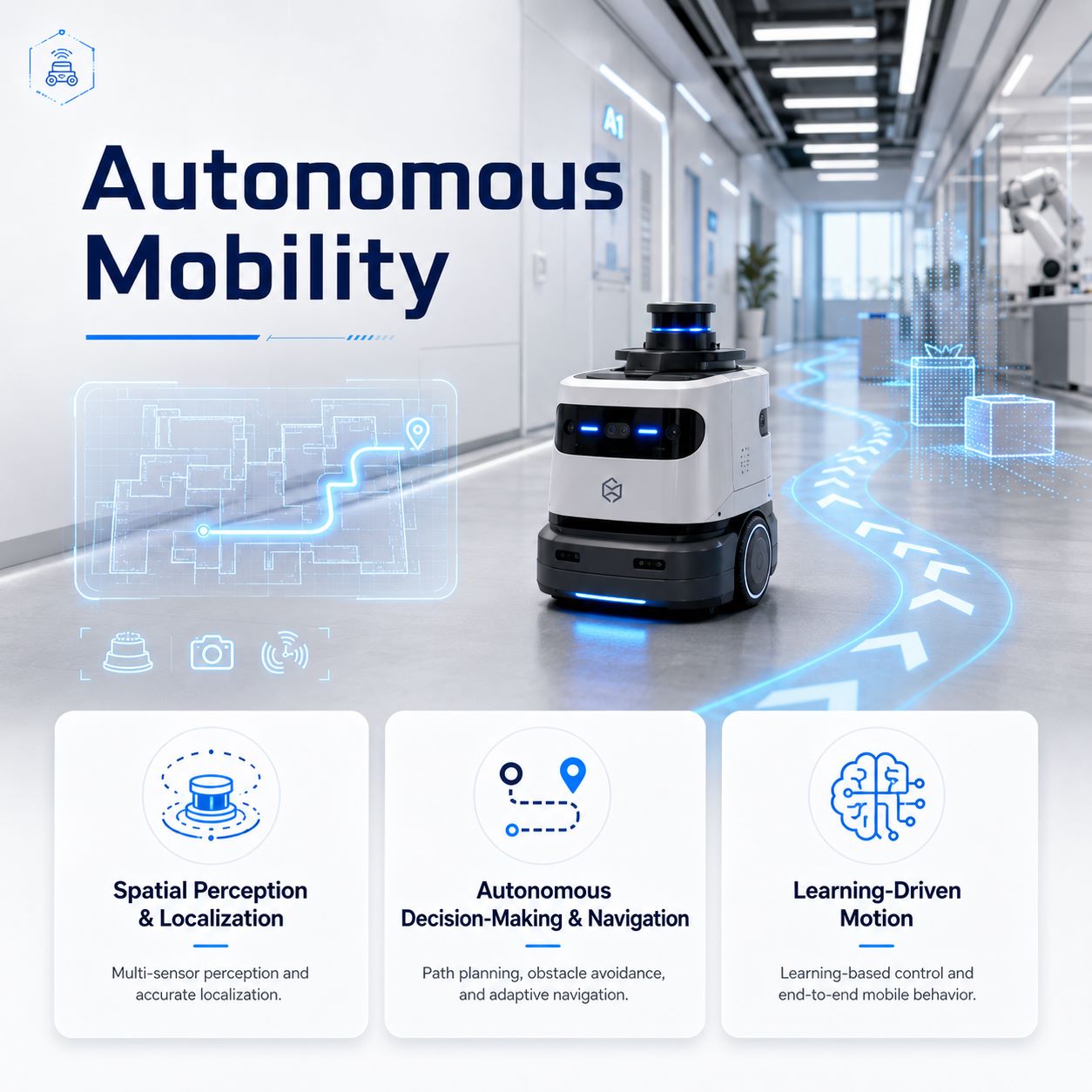
Autonomous Mobility
We develop perception, localization, decision-making, and motion methods that enable mobile robots to navigate safely in complex real-world environments. This direction studies modular navigation pipelines and learning-driven motion policies, with an emphasis on reliability, adaptability, and deployment.
- Spatial Perception & Localization: building scene perception, state estimation, mapping, and localization methods for dynamic environments.
- Autonomous Decision-Making & Navigation: designing planning, obstacle avoidance, behavior selection, and navigation strategies for efficient mobility.
- Learning-Driven Motion: exploring data-driven and end-to-end approaches for motion generation, policy adaptation, and generalization.
Spatial Perception & Localization · Autonomous Decision-Making & Navigation · Learning-Driven Motion
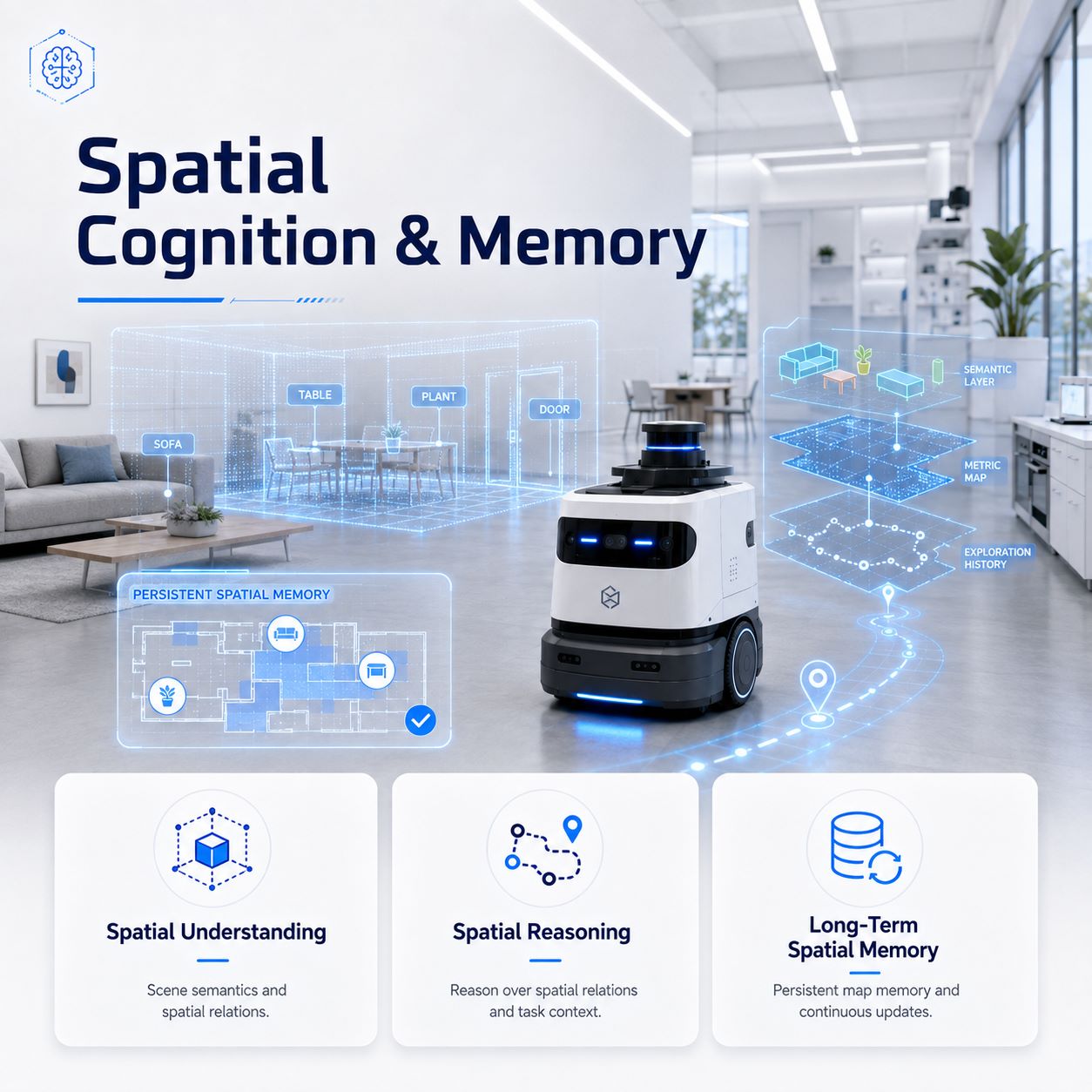
Spatial Cognition & Memory
We study how robots understand scenes, objects, places, and spatial relationships, and how they build long-term memory to reason about changing environments. This direction focuses on organizing spatial knowledge over time so robots can recognize environmental structure, detect changes, and support long-term autonomous behavior.
- Spatial Understanding: representing scenes, objects, regions, and semantic structures so robots can interpret the meaning of their surroundings.
- Spatial Reasoning: inferring spatial relationships, traversability, scene changes, and task-relevant constraints from accumulated environmental information.
- Long-Term Spatial Memory: storing, updating, retrieving, and evolving spatial knowledge to support persistent awareness in changing real-world spaces.
Spatial Understanding · Spatial Reasoning · Long-Term Spatial Memory
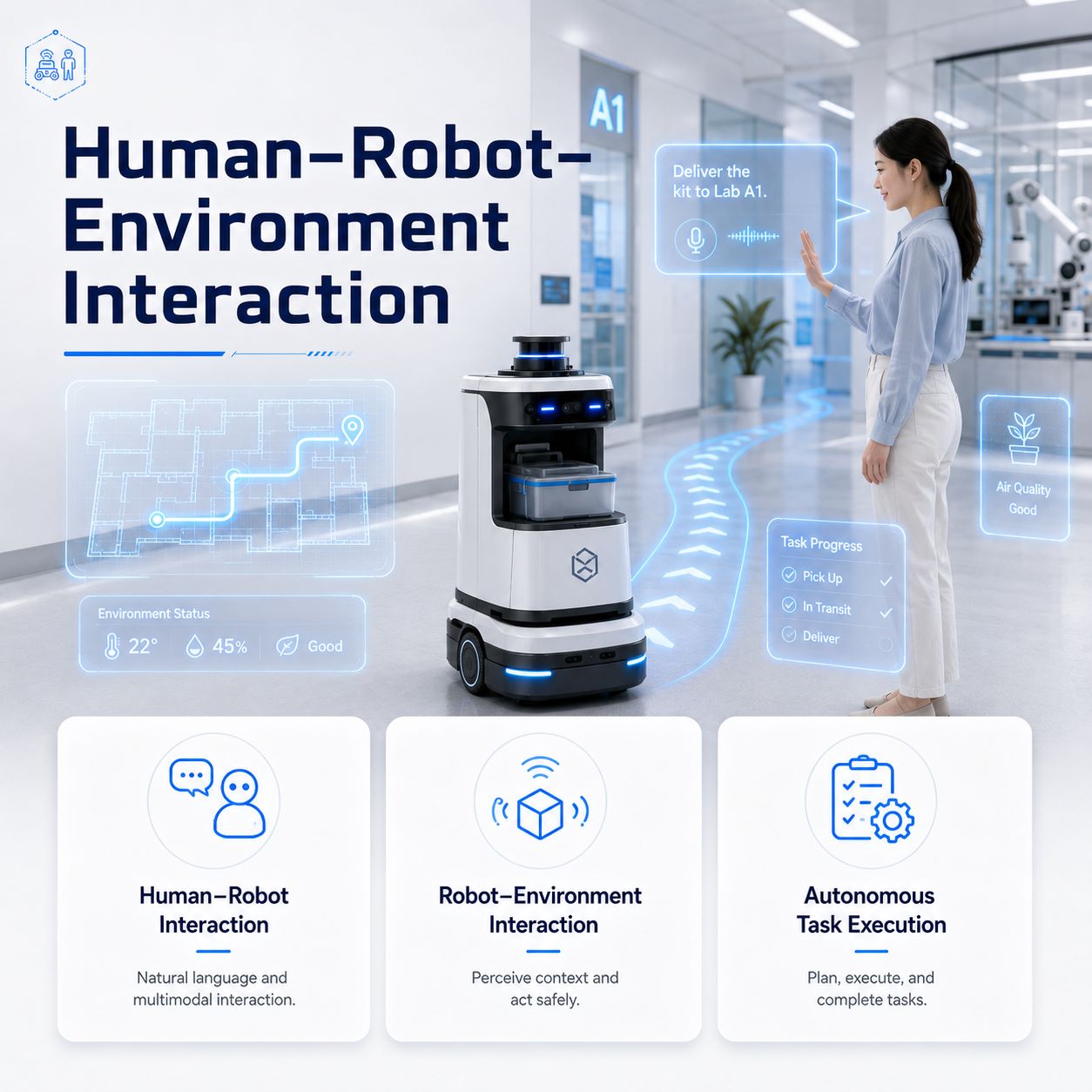
Human–Robot–Environment Interaction
We explore how robots understand human intentions, use environmental information, and plan actions autonomously for reliable service and task execution. This direction connects spatial intelligence with interactive robot behavior, enabling robots to cooperate with people and act effectively in everyday environments.
- Human–Robot Interaction: studying intention understanding, instruction interpretation, and natural communication between humans and mobile robots.
- Robot–Environment Interaction: enabling robots to perceive, use, and modify environmental information while executing actions in real-world scenes.
- Autonomous Task Execution: integrating perception, memory, planning, and interaction to complete complex tasks with minimal human intervention.
Human–Robot Interaction · Robot–Environment Interaction · Autonomous Task Execution
We are looking for motivated students and collaborators in mobile robot spatial intelligence.
Principal Investigator


Ph.D. Students

Master's Students
Undergraduate Students
Alumni